
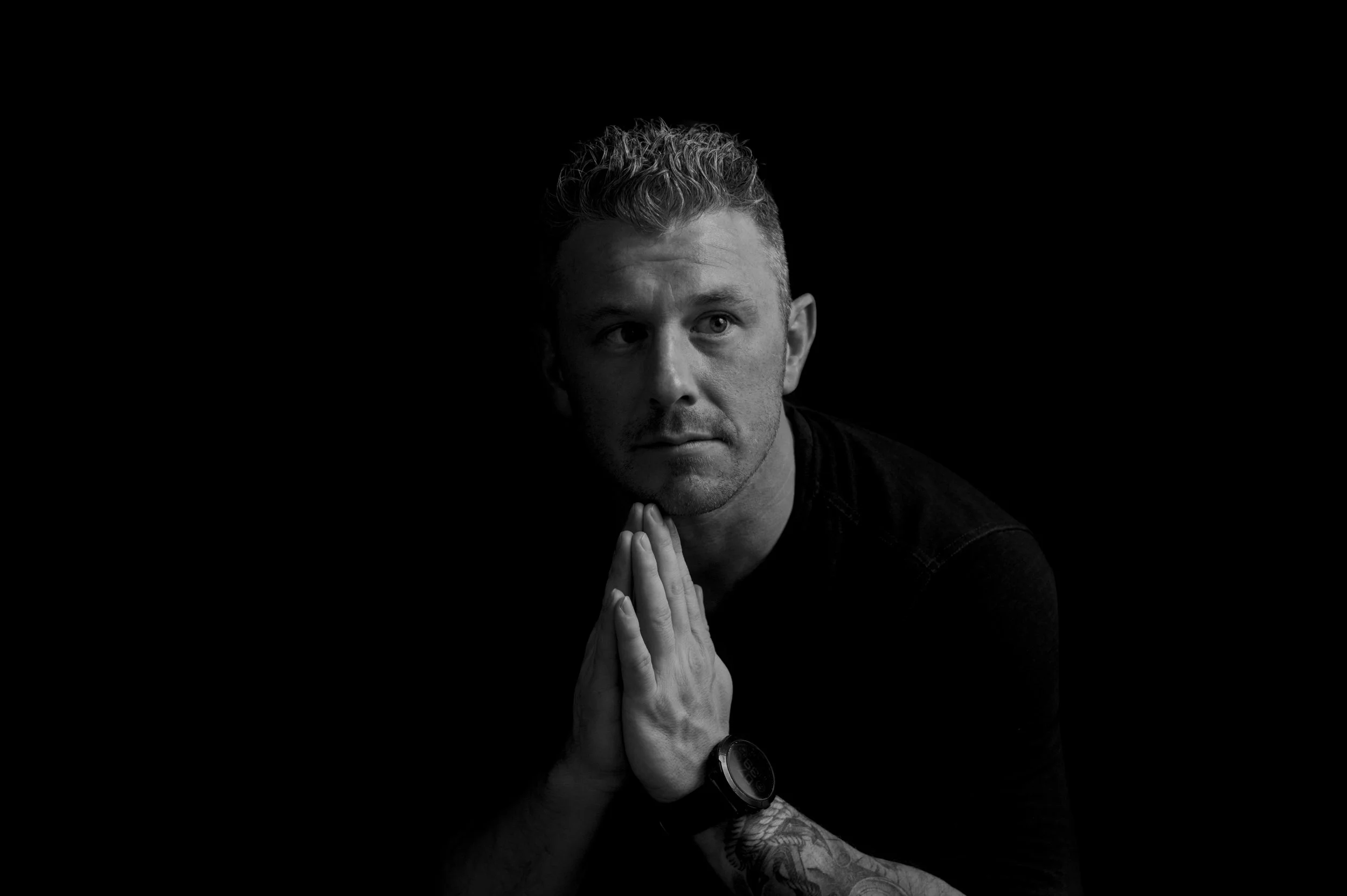
— ABOUTMy name is Chris. I'm a grateful recovering drug addict.
Here's the long version of the story most men only know in fragments.
m Chris. Recovery coach, founder of Man Made Men, contributing author of The Sovereign Man, host of the
I’
Swing For The Kids charity tournament. Based in Kamloops, BC. Clean since October 29, 2021.
I'm not a therapist. I'm not running an AA program. I'm a coach who's been to the depths of hell and built a working process for getting out — and a man who is still doing the work alongside the men I work with.
If you're going to work with me, you should know who you're working with. So here it is.
— ABOUTHow I got here.
My childhood taught me how to read a room before I could read a book. By high school I'd built a survival blueprint — stay agreeable, lean on humour, earn approval — and it worked. I belonged anywhere I needed to. What it cost me wouldn't show up for years.
At thirteen, I found alcohol. By thirty, I'd added the rest. From the outside I looked like a man with his ducks in a row — career, house, partner. From the inside, I was running out of road.
The full version of how I got from that house party to a basement in Kamloops with a thought I couldn't outrun is the chapter I wrote for The Sovereign Man. It's called 'Wired.' If you want the long version, that's where it lives.
What I'll tell you here is what came after.
"You don't have a drug problem. You have a connection problem."
— FROM MODULE 1, 6 WEEKS TO SOBER
— THE TURNING POINTWhat I learned in treatment.
Six weeks of treatment cracked something open that had been welded shut for thirty years;
I didn't have a drug problem. I had a Chris problem — and the drugs were just my 'solution' to it.
That distinction is the foundation of everything I do now. Sobriety and recovery are two different things. Sobriety is putting the substance down. Recovery is doing the work the substance was protecting you from. The first one is hard. The second one is harder. And the second one is where every man who's ever made it out has had to live.
— WHAT I BELIEVEA few things I won't compromise on.
You don't have a drug problem. You have a connection problem.
To yourself, to the people you love, to what you're actually here for. The substance is the symptom. The disconnection is the cause. Until you face the second one, the first one keeps coming back — sometimes as a drink, sometimes as a phone, sometimes as work, sometimes as something worse.
You're not broken. You're wired.
The patterns that became your prison were once how you survived. They were intelligent. They were necessary. They were yours. They are also rewireable. What's wired in can be rewired — and that is a software issue, not a hardware issue.
Recovery isn't an event. It's a redesign.
There's a phrase in 12-step programs: "the only thing you have to change is everything." That used to terrify me. Now I think it's the most freeing sentence in recovery. Everything is on the table — and the man who walks out the other side is one you haven't met yet.
Nobody is coming to save you.
Not me, not the program, not your partner, not your bank account, not your past version of yourself. It may not be your fault you ended up here. It is entirely your responsibility to find a way out. But you are not alone in the work. There is a difference.
— HOW I WORKHow I work.
I do this work alongside you, not for you. I won't carry your sobriety. I will hand you the same tools that got me here — the ones I built from hundreds of NA meetings, hundreds of hours of counselling, men's groups, retreats, books, podcasts, stepwork — and I'll do the work in front of you while you do it next to me.
The approach is structured. The 6 Weeks to Sober and 12 Weeks of Transformation programs walk through a specific arc — Origin, Patterns, Vision, Internal Work, Relationships, Long Game — because random insights don't build new lives. Integrated practice does.
It's also direct. I'll call out a pattern faster than you'll see it. I'll ask the question you've been ducking. I won't fawn, and I won't soften the work. Most men I've worked with say the relief is in being talked to like a man, not a patient.
And it's ongoing. The Alumni 4-Pack exists because the work doesn't end at week six or twelve. The men who get the most out of this don't graduate from coaching. They keep someone in their corner.
"It may not be your fault you ended up here.
It is entirely your responsibility to find a way out."
— OUTSIDE THE WORKLife on this side of it.
I live in Kamloops, BC. I own and operate Bass Operations Ltd, working as a senior board operator at a natural gas processing facility in Dawson Creek. That's the work that pays. This is the work that matters. I attend a weekly men's group. I see a counsellor every three weeks. I'm still going to NA meetings years into recovery. The work isn't behind me. I'm still doing it.
Every July I host the Swing For The Kids slo-pitch tournament here in Kamloops. Four years running, all proceeds to KidSport Kamloops, presented by Man Made Men. It's where the practice of recovery meets the practice of community — showing up for a thing that has nothing to do with my own healing and everything to do with kids who need someone in their corner.
Outside of all of it: I'm a man who learned, late, how to be still. How to feel things without managing them. How to stop performing for the room and start showing up for the people in it. I'm not finished. Nobody is. But I'm here, doing the next right thing, one day at a time.
Oct 29, 2021
CLEAN DATE
1,000+
HOURS IN THE WORK
Author
THE SOVEREIGN MAN
Founder
SWING FOR THE KIDS
— IF THIS SOUNDED FAMILIARLet's get on a call.
The Jumpstart Call is free. Twenty minutes on Zoom. No pitch, no commitment. You tell me what's going on. I tell you whether I think I can help. We go from there.